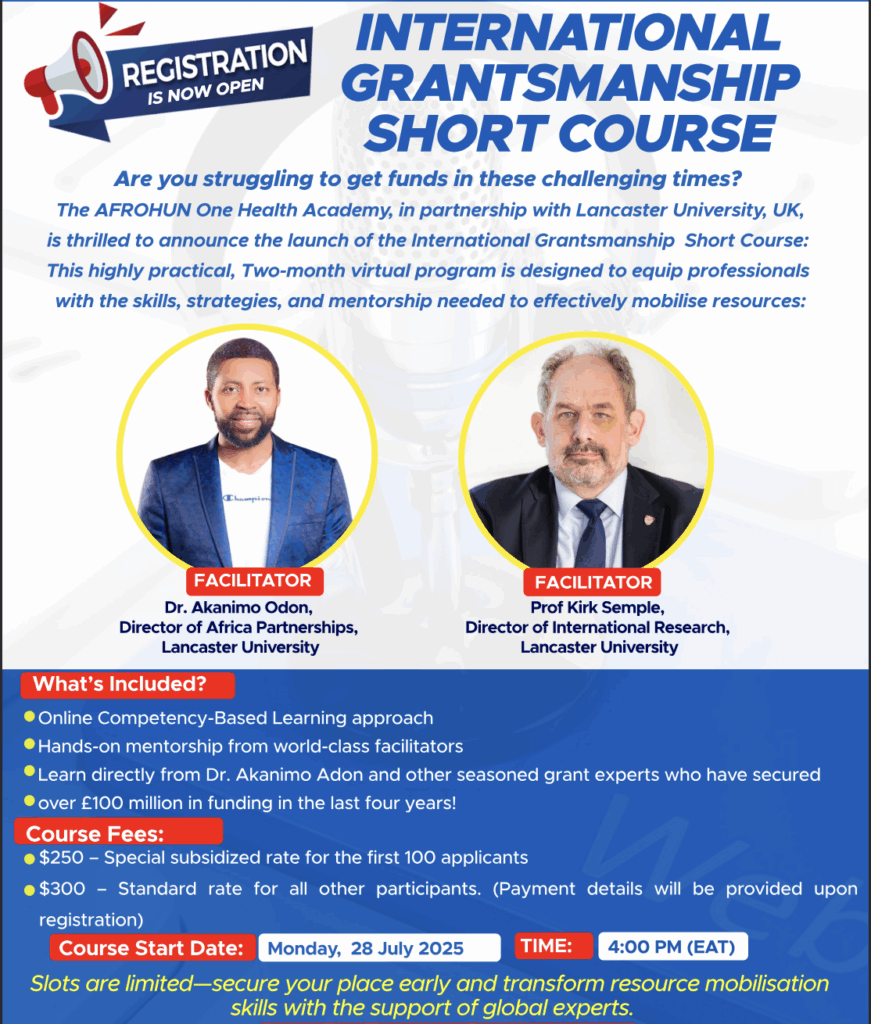

A TWO MONTHS CPD IN RESOURCE MOBILIZATION AND GRANTSMANSHIP: HOW TO SOURCE AND APPLY FOR AND WIN INTERNATIONAL FUNDING
PROGRAMME OVERVIEW
Is it the availability of funding or the accessibility to funding? If I asked you to list the top ten international organizations that gives funding in your field or expertise, would you know them? If you don’t know them, then how can you be looking for money and don’t know who gives money?
Funding is a huge challenge that many science, research and innovation organizations face. However, there is an increase in the numbers and sources of international grants focused on Africa, yet organizations still struggle to align themselves with these funding opportunities and even lack the capacity and institutional skills to source, apply for and win these sorts of grants.
International Partnerships are a good way to access alternative resources and generally organizations have lots of Memorandum of Understanding (MOUs) but most of these MOUs remain unused and gather dust on shelves. It requires the right knowledge, expertise, skills, and resources to activate and operationalize these MOUs and drive resource mobilization through sustainable grantsmanship approaches.
In most African countries, public organisations depend wholly on their government who now struggle to fund them; they don’t speak with private sector folks who can potentially fund them; personal consulting is huge but secret so institutions benefit nothing; they don’t engage with sources who can give more funding; MoUs that can attract funding gather dusts on shelves; access to increasing international research grants is a struggle; and when they apply for grants, proposals are poor; delivering new programmes for revenue is an alien concept; investing in distance learning and exploiting the huge potential for distance learning is still unclear and problematic.
PROGRAMME OBJECTIVES
The key objectives of this programme include:
- To expose participants to new and innovative resource mobilization models and the process of developing a robust and effective personal culture, institutional policy, organizational strategy and plans for resource mobilization.
- To empower participants with the knowledge of how to source for funding opportunities, plan and prepare for them, articulate the right partnerships, and apply to win them.
- To empower participants with vital information, resource, and knowledge on how to align their institutions structures, framework, and operations to increasing resource mobilization and international grantsmanship.
- Participants will learn about the models of bridging the gaps between academia, research and industry to be able to increase their economic impact through research, alternative funding streams for sustainable impact.
- Participants will learn about the availability of specific international funding for collaborative projects and programmes and how to access and align themselves to winning them.
- Participants will learn how to tap into the growing opportunities in Africa and how to internationalize their operations and strategies to take advantage of these opportunities for resource mobilization.
PROGRAMME OUTLINE
There are five modules for this CPD Programme in Resource Mobilization and International Grantsmanship and they are regarded as the 5 Ps of Resource Mobilization and international Funding.
- The Problem Module – All funding is based on identifying and crafting a significant challenge(s) or problem(s) for which the funding is required. This problem needs to be viewed from a multi-disciplinary perspective and backed up by evidence (data) of relevance and impact. How does one articulate a case for support in a clear and captivating manner?
- The People Module – It is a mistake to assume that setting up a funding application and sourcing landscape can be undertaken in isolation. In this era, it requires a strategic framework, structure, and system to be put in place for efficiency and success and so working in groups and teams is fundamental for winning international funding for projects, business, and research. Who should make up this team and why?
- The Partnership Module – In the new post-COVID international funding landscape, funders are interested in strategic partnerships for impact. This can be viewed through different lenses: the quadruple helix lenses of partners (academia, industry, government, and communities/civil societies); the multi-disciplinary lenses of subject matter interactivity; the geographical location of impact lenses as well as the pathway to impact partners lenses. What are these lenses and how should they be mapped for a robust and compelling funding proposal?
- The Preparation Module – Ultimately, funding applications are assessed by documentations and there are a wide range of documentations that are required for most funding proposals. Some are standard (Curriculum Vitae, Letters of Support; Track Record; Profile of applicants and partners etc), Others are most strategic and relevant to the nature of the funding (Risk Management Plan; Communication Plan, Project Management Plan; Financial Management Plan; Stakeholder Management Plan etc). How can these documentations be articulated and crafted so that they are easy to adopt and or adapt for different funding opportunities? How can they be developed and presented for accessibility, clarity, and objectivity with clear alignment to funders’ expectations?
- The Practice Module – At the end of these programme modules, there will then be a special final module design for participants to practice and develop confidence in sourcing for, applying for and winning international funding.